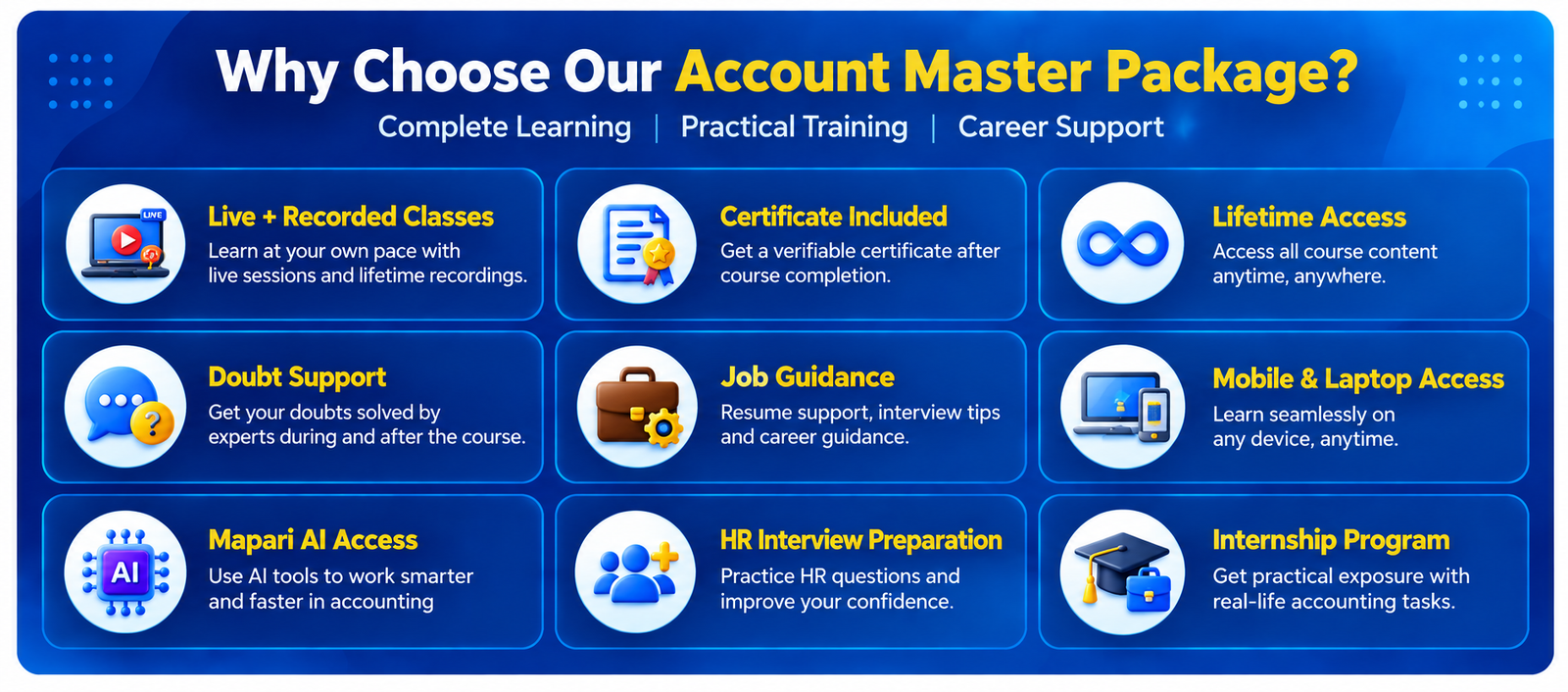
WHY CHOOSE THIS PACKAGE?
Start from Zero to Master Level
10 Learning Levels & 86 Practical Modules
GST, TDS, Payroll, Finalization & Advanced Excel
Real Business Projects & Work
Live + Recorded Classes with Doubt Support
Mapari AI Access for Smarter Learning
Technical + HR Interview Preparation
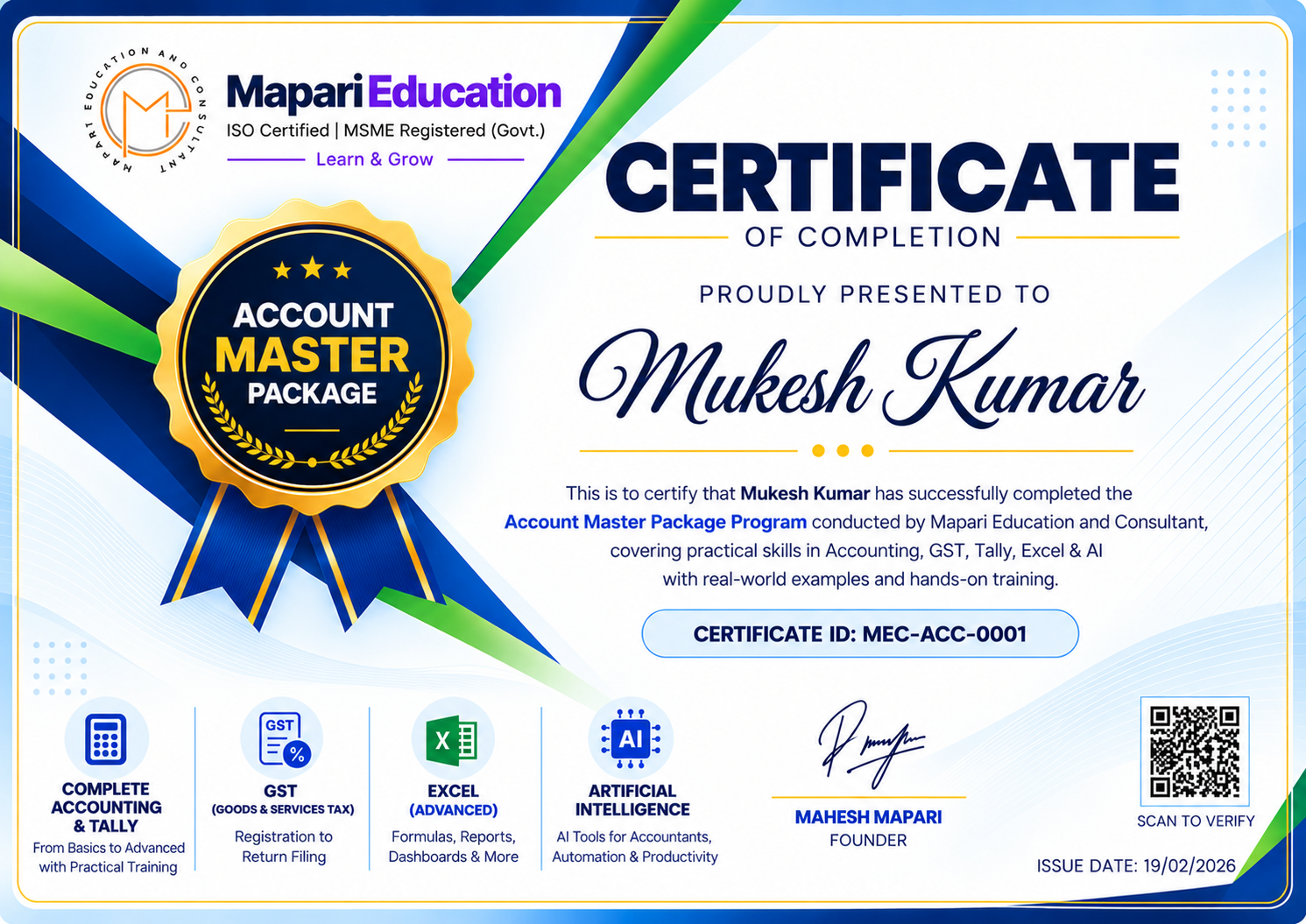
Certificate After Successful Assessment
1-Year Job Portal Access & Career Guidance
Complete Account Master Package at a one-time Technical & Learning Infrastructure Fee of ₹999.
Certificate eligibility: complete the required lessons, practical assignments and applicable assessment requirements.
Account Master Package Syllabus
Level 1 ACCOUNTING FOUNDATION 10 modules
01
Introduction to Accounting 2 Chapters
Chapter 1: Accounting Fundamentals
Meaning and definition of accounting
Objectives and importance of accounting
Bookkeeping vs accounting
Types of accounting
Users of accounting information
Chapter 2: Business and Accounts Department
Types of business organizations
Functions of an accounts department
Roles and responsibilities of accountants
Accounting workflow in a company
Basic accounting terminology
02
Basic Accounting Concepts 2 Chapters
Chapter 1: Accounting Principles
Business entity concept
Going concern concept
Accrual and cash basis
Matching and consistency principles
Materiality and prudence
Accounting Standards, Ind AS and GAAP overview
Chapter 2: Accounting Equation
Assets, liabilities and capital
Income, expenses and drawings
Accounting equation
Effect of transactions on accounting equation
Classification of accounts
03
Debit, Credit and Journal Entries 2 Chapters
Chapter 1: Rules of Debit and Credit
Traditional golden rules
Modern accounting rules
Debit and credit identification
Double-entry system
Normal balances of accounts
Chapter 2: Journal Entries
Journal entry format
Cash and credit transactions
Purchase and sales entries
Expense and income entries
Compound journal entries
Practical journal entry exercises
04
Accounting Documents 2 Chapters
Chapter 1: Source Documents
Tax invoices and bills
Receipts and payment vouchers
Debit notes and credit notes
Purchase orders and delivery challans
Bank statements and payment advice
Chapter 2: Document Verification
Checking invoice details
Supporting documents
Authorization and approvals
Document numbering
Filing and record retention
Identifying duplicate or incorrect bills
05
Ledger and Trial Balance 2 Chapters
Chapter 1: Ledger Accounting
Meaning and format of ledger
Posting journal entries
Ledger balancing
General ledger and subsidiary ledgers
Customer and vendor ledgers
Chapter 2: Trial Balance
Preparation of trial balance
Debit and credit balances
Trial balance verification
Common accounting errors
Suspense account introduction
06
Cash Book and Petty Cash 2 Chapters
Chapter 1: Cash Transactions
Single-column and double-column cash book
Cash receipts and payments
Cash balance verification
Cash deposit and withdrawal
Daily cash closing
Chapter 2: Petty Cash
Imprest system
Petty cash vouchers
Expense categorization
Petty cash reimbursement
Cash verification and controls
07
Bank Accounting 2 Chapters
Chapter 1: Banking Transactions
Bank account types
NEFT, RTGS, IMPS and UPI
Cheque receipts and payments
Bank charges and interest
Bank ledger accounting
Chapter 2: Bank Reconciliation
Meaning of bank reconciliation
Cash book vs bank statement
Outstanding cheques
Deposits in transit
Bank reconciliation statement preparation
Practical reconciliation exercises
08
Purchase and Sales Accounting 2 Chapters
Chapter 1: Purchase Accounting
Cash and credit purchases
Purchase invoice booking
Purchase returns
Freight and additional expenses
Supplier ledger reconciliation
Chapter 2: Sales Accounting
Cash and credit sales
Sales invoice preparation
Sales returns
Customer receipts
Discounts and adjustments
Customer ledger reconciliation
09
Adjustments and Rectification 2 Chapters
Chapter 1: Adjustment Entries
Outstanding expenses
Prepaid expenses
Accrued income
Income received in advance
Depreciation
Provisions and adjustments
Chapter 2: Rectification of Errors
Errors of omission and commission
Errors of principle
Wrong ledger posting
Reversal and correction entries
Suspense account adjustment
10
Basic Financial Statements 2 Chapters
Chapter 1: Trading and Profit & Loss Account
Direct and indirect expenses
Gross profit calculation
Net profit calculation
Closing stock treatment
Profit & Loss preparation
Chapter 2: Balance Sheet
Assets and liabilities classification
Capital and reserves
Current and non-current items
Balance sheet preparation
Relationship between P&L and balance sheet
Level 2 ACCOUNTING SOFTWARE & EXCEL 8 modules
11
TallyPrime Fundamentals 2 Chapters
Chapter 1: Company Setup
Introduction to TallyPrime
Company creation and alteration
Financial year configuration
Security and user access
Accounting features and settings
Chapter 2: Masters
Groups and ledgers
Stock groups and stock items
Units of measurement
Cost centres
GST and tax configurations
Opening balances
12
TallyPrime Voucher Entry 2 Chapters
Chapter 1: Accounting Vouchers
Contra voucher
Payment voucher
Receipt voucher
Journal voucher
Purchase voucher
Sales voucher
Debit note and credit note
Chapter 2: Practical Transactions
Purchase and sales with GST
Cash and bank transactions
Expense booking
Customer and supplier advances
Bill-wise accounting
Voucher alteration and cancellation
13
TallyPrime Advanced Features 2 Chapters
Chapter 1: Advanced Accounting
Cost centres and categories
Inventory accounting
Purchase and sales orders
Delivery and receipt notes
Interest calculations
Multi-currency transactions
Chapter 2: Data Management
Data backup and restore
Data import and export
User access control
Audit and edit logs
Company data verification
Year-end data management
14
TallyPrime Reporting 2 Chapters
Chapter 1: Operational Reports
Day book
Ledger reports
Outstanding receivables
Outstanding payables
Stock summary
Bank reconciliation
Chapter 2: Financial Reports
Trial balance
Profit & Loss account
Balance sheet
Cash flow report
GST reports
TDS reports
Report export to Excel
15
Excel for Accountants 2 Chapters
Chapter 1: Excel Essentials
Workbook and worksheet management
Data entry and formatting
Sorting and filtering
Cell references
Basic formulas
Data validation
Chapter 2: Practical Accounting Excel
SUM, SUMIF and SUMIFS
COUNTIF and COUNTIFS
IF and IFERROR
VLOOKUP and XLOOKUP
Date formulas
Customer and vendor reconciliation sheets
16
Advanced Excel and MIS 2 Chapters
Chapter 1: Data Analysis
Pivot tables
Pivot charts
Conditional formatting
Advanced filtering
Text and date functions
Power Query introduction
Chapter 2: Reporting
Monthly expense reports
Sales and purchase analysis
Receivables ageing
Budget vs actual reports
Dashboard preparation
Management MIS templates
17
Other Accounting Software and ERP 2 Chapters
Chapter 1: Accounting Software Exposure
BUSY accounting software overview
SAP accounting introduction
Oracle ERP introduction
Cloud accounting concepts
Comparison of accounting systems
Chapter 2: ERP Workflows
Procure-to-pay cycle
Order-to-cash cycle
Record-to-report cycle
Master data management
ERP approvals and controls
Accounting system integration
18
Accounting Data Controls 2 Chapters
Chapter 1: Data Quality
Master data verification
Duplicate ledger prevention
Transaction validation
Opening balance verification
Data reconciliation
Chapter 2: Security
User permissions
Password and access controls
Backup policies
Audit trails
Data confidentiality
Error prevention procedures
Level 3 DAILY BUSINESS ACCOUNTING 10 modules
19
Accounts Payable 2 Chapters
Chapter 1: Vendor Management
Vendor onboarding
Vendor master verification
Purchase order matching
Invoice verification
Vendor ledger maintenance
Payables ageing
Chapter 2: Payment Processing
Payment approval process
Payment scheduling
Advance payments
Debit notes and adjustments
Vendor reconciliation
Payment advice preparation
20
Accounts Receivable 2 Chapters
Chapter 1: Customer Accounting
Customer onboarding
Credit limits and terms
Sales invoice accounting
Customer receipts
Credit notes
Receivables ageing
Chapter 2: Collection Management
Outstanding follow-up
Payment reminders
Customer reconciliation
Short and excess receipts
Bad debts and provisions
Collection reporting
21
Inventory Accounting 2 Chapters
Chapter 1: Stock Operations
Inventory types
Goods receipt notes
Goods issue notes
Stock transfers
Stock adjustments
Physical stock verification
Chapter 2: Inventory Valuation
FIFO and weighted average
Inventory valuation principles
Closing stock calculation
Stock reconciliation
Slow-moving and obsolete stock
Inventory control reports
22
Fixed Assets 2 Chapters
Chapter 1: Asset Accounting
Fixed asset register
Asset capitalization
Asset classification
Asset purchases
Asset transfers
Asset disposal
Chapter 2: Depreciation
Straight-line method
Written-down value method
Book depreciation
Tax depreciation overview
Depreciation schedules
Asset reconciliation
23
Expense Management 2 Chapters
Chapter 1: Expense Booking
Direct and indirect expenses
Expense classification
Employee reimbursements
Recurring expenses
Accrual accounting
Prepaid expenses
Chapter 2: Expense Controls
Expense approval matrix
Supporting bill verification
Budget controls
Duplicate expense detection
Expense reconciliation
Monthly expense analysis
24
Advances, Deposits and Loans 2 Chapters
Chapter 1: Advances and Deposits
Employee advances
Vendor advances
Customer advances
Security deposits
Advance adjustment
Balance confirmation
Chapter 2: Borrowings
Loan accounting
Principal and interest entries
EMI accounting
Loan amortization schedules
Loan ledger reconciliation
Interest accrual
25
Interbranch and Intercompany Accounting 2 Chapters
Chapter 1: Branch Accounting
Branch transactions
Head office accounting
Interbranch transfers
Branch expense allocation
Branch reconciliation
Chapter 2: Group Transactions
Intercompany purchases and sales
Intercompany loans
Intercompany balances
Reconciliation of group accounts
Consolidation introduction
26
Import and Export Accounting 2 Chapters
Chapter 1: Imports
Import purchase orders
Commercial invoices
Bills of entry
Customs duty and import IGST
Foreign currency payments
Import cost calculation
Chapter 2: Exports
Export invoices
Shipping bills
Export documentation
Export proceeds
Foreign exchange differences
Export GST treatment overview
27
E-commerce and Digital Transactions 2 Chapters
Chapter 1: Online Sales
Marketplace sales accounting
Payment gateway transactions
Marketplace commissions
Returns and refunds
Discounts and promotional adjustments
Chapter 2: Reconciliation
Marketplace settlement reports
Payment gateway reconciliation
TDS and TCS entries where applicable
Bank settlement matching
Sales reconciliation
Outstanding settlement tracking
28
Practical Monthly Accounting Cycle 2 Chapters
Chapter 1: Daily-to-Monthly Workflow
Daily voucher verification
Cash and bank closing
Purchase and sales review
Vendor and customer reconciliation
Expense accruals
Inventory verification
Chapter 2: Monthly Closure
GST and TDS reconciliation
Payroll accounting
Fixed asset depreciation
Trial balance review
Monthly financial statements
Management reporting
Level 4 GST COMPLIANCE 10 modules
29
GST Fundamentals 2 Chapters
Chapter 1: GST Structure
Introduction to GST
CGST, SGST, IGST and UTGST
Supply of goods and services
Taxable, exempt and zero-rated supplies
Place of supply overview
Chapter 2: GST Applicability
GST registration concepts
Composition scheme
Reverse charge mechanism
GST rates and classification
HSN and SAC codes
GST accounting entries
30
GST Registration and Portal 2 Chapters
Chapter 1: GST Registration
Registration eligibility
Registration documents
GSTIN structure
Registration application
Amendments and cancellation
Additional place of business
Chapter 2: GST Portal Operations
GST portal navigation
Electronic cash ledger
Electronic credit ledger
Electronic liability register
Challan creation
Notices and acknowledgements
31
GST Invoicing 2 Chapters
Chapter 1: Invoice Compliance
Tax invoice requirements
Bill of supply
Debit notes and credit notes
Receipt and payment vouchers
Invoice numbering
HSN/SAC reporting
Chapter 2: Special Transactions
B2B and B2C invoicing
Interstate sales
Exports
Advances
Discounts
Reverse charge transactions
32
Input Tax Credit 2 Chapters
Chapter 1: ITC Eligibility
Input tax credit concept
Eligible and ineligible ITC
Blocked credits
Conditions for ITC
ITC reversals
Capital goods ITC
Chapter 2: ITC Reconciliation
Purchase register preparation
GSTR-2B reconciliation
Missing invoices
Vendor follow-up
ITC mismatch resolution
ITC working papers
33
GST Returns 2 Chapters
Chapter 1: Outward Supply Reporting
GSTR-1 preparation
B2B invoice reporting
B2C reporting
Credit and debit notes
Amendments and GSTR-1A
Sales register reconciliation
Chapter 2: GSTR-3B
Outward tax liability
ITC reporting
Reverse charge reporting
Tax payment calculation
Electronic ledger adjustment
Return filing workflow
34
Advanced GST Returns 2 Chapters
Chapter 1: Other GST Returns
CMP-08
GSTR-4
GSTR-9
GSTR-9C
GSTR-7 and GSTR-8
Applicability of special returns
Chapter 2: Annual GST Review
Annual turnover reconciliation
GST liability reconciliation
ITC annual review
Credit and debit note reconciliation
Annual return working papers
Difference identification
35
E-Invoicing and E-Way Bill 2 Chapters
Chapter 1: E-Invoicing
E-invoicing applicability
Invoice Registration Portal
IRN generation
QR code
Invoice cancellation
ERP integration
Chapter 2: E-Way Bill
E-way bill applicability
Part A and Part B
E-way bill generation
Vehicle updates
Cancellation and validity
Common compliance errors
36
GST Reconciliation 2 Chapters
Chapter 1: Sales Reconciliation
Books vs GSTR-1
GSTR-1 vs GSTR-3B
E-invoice reconciliation
Credit note verification
Tax liability differences
Chapter 2: Purchase Reconciliation
Purchase register vs GSTR-2B
ITC claimed vs eligible ITC
Supplier mismatch reports
Reverse charge reconciliation
GST ledger reconciliation
Monthly GST reconciliation workbook
37
GST Notices and Assessments 2 Chapters
Chapter 1: Department Communications
Types of GST notices
GST portal notice tracking
Mismatch notices
Demand notices
Supporting document preparation
Chapter 2: Practical Response
Notice analysis
Reconciliation preparation
Drafting factual replies
Document submission
Tracking response status
Escalation to tax professionals
38
Special GST Transactions 2 Chapters
Chapter 1: Specialized Treatment
Job work
Branch transfers
Export under LUT
SEZ supplies
Imports
Reverse charge transactions
Chapter 2: Complex Scenarios
Mixed and composite supplies
Discounts and incentives
Free samples and gifts
Credit note adjustments
Common ITC disputes
Practical GST case studies
Level 5 INCOME TAX, TDS AND TCS 9 modules
39
Income Tax Fundamentals 2 Chapters
Chapter 1: Tax Structure
Direct tax fundamentals
Income-tax legislation
Tax year and applicable assessment periods
Residential status
Heads of income
Taxpayer categories
Chapter 2: Tax Computation
Gross total income
Deductions and exemptions
Taxable income
Tax rates and regimes
Surcharge and cess
Advance tax and self-assessment tax
40
Business Income Computation 2 Chapters
Chapter 1: Profit-to-Taxable-Income
Book profit vs taxable profit
Allowable business expenses
Disallowable expenses
Depreciation adjustments
Provisions and adjustments
Tax computation working
Chapter 2: Business Tax Matters
Presumptive taxation overview
Business losses
Carry-forward and set-off
Advance tax computation
Tax provisions
Business tax documentation
41
TDS Fundamentals 2 Chapters
Chapter 1: TDS Basics
Meaning and purpose of TDS
TAN and PAN
Deductor responsibilities
TDS applicability
Thresholds and rates
Timing of deduction
Chapter 2: Common Payments
Salary payments
Contractor payments
Professional fees
Rent
Interest
Commission and brokerage
42
TDS Practical Accounting 2 Chapters
Chapter 1: Deduction and Deposit
Vendor invoice with TDS
Expense booking
TDS payable ledger
TDS challan preparation
Payment accounting
Interest and late fees
Chapter 2: Reconciliation
TDS ledger reconciliation
Deduction register
Challan reconciliation
Vendor-wise TDS reports
Short and excess deduction
Month-end TDS working
43
TDS Returns and TRACES 2 Chapters
Chapter 1: Quarterly Statements
Salary TDS statements
Non-salary TDS statements
Non-resident payment statements
Statement preparation
Validation and filing
Correction statements
Chapter 2: TRACES Operations
TRACES registration
Challan status
Justification reports
TDS certificates
Defaults and corrections
Annual TDS reconciliation
44
TCS Compliance 2 Chapters
Chapter 1: TCS Concepts
Meaning of TCS
Applicable transactions
Collection timing
TCS accounting entries
TCS payable reconciliation
Chapter 2: Returns
TCS return preparation
Form 27EQ and current applicable forms
Challan verification
TCS certificates
Correction statements
TCS reconciliation
45
Income Tax Returns 2 Chapters
Chapter 1: Return Preparation
ITR applicability
Taxpayer details
Financial statements and schedules
Income computation
Tax credits
Return verification
Chapter 2: E-Filing
Income-tax portal
ITR preparation utilities
Return filing workflow
E-verification
Revised and updated returns
Acknowledgement and recordkeeping
46
Tax Reconciliation and Tax Audit 2 Chapters
Chapter 1: Tax Credits
Form 26AS
Annual Information Statement
TDS and TCS reconciliation
Advance tax reconciliation
Tax credit mismatches
Chapter 2: Audit Preparation
Tax audit applicability
Books and supporting schedules
Expense verification
Statutory dues reconciliation
Audit documentation
Coordination with tax auditors
47
Income Tax Notices and Assessments 2 Chapters
Chapter 1: Compliance Issues
Income-tax intimations
Demand notices
Tax credit mismatches
Return defects
Assessment communications
Chapter 2: Response Management
Notice review
Supporting document collection
Tax reconciliation
Drafting factual responses
Online response workflow
Escalation and professional review
Level 6 PAYROLL AND STATUTORY COMPLIANCE 6 modules
48
Payroll Fundamentals 2 Chapters
Chapter 1: Salary Structure
CTC vs gross salary
Basic salary and allowances
Salary deductions
Attendance and leave
Overtime and incentives
Employee master data
Chapter 2: Payroll Processing
Monthly payroll inputs
Salary calculations
Payslip preparation
Salary journal entries
Salary payment processing
Payroll reconciliation
49
PF and ESI 2 Chapters
Chapter 1: Provident Fund
EPF applicability
Employee and employer contributions
UAN and member details
Monthly contribution working
ECR preparation
PF payment and reconciliation
Chapter 2: Employee State Insurance
ESI applicability
Employee registration
ESI contributions
Monthly contribution working
Payment process
ESI reconciliation
50
Professional Tax and Labour Compliance 2 Chapters
Chapter 1: State Compliance
Professional tax applicability
State-specific registration
Employee deductions
Employer liabilities
Returns and payment process
Chapter 2: Labour Records
Attendance register
Wage register
Leave records
Statutory employee records
Compliance calendar
Document retention
51
Employee Benefits and Full & Final Settlement 2 Chapters
Chapter 1: Employee Benefits
Bonus
Gratuity
Leave encashment
Reimbursements
Employee loans and advances
Employee benefit provisions
Chapter 2: Employee Exit
Resignation and exit documentation
Notice period recovery
Pending salary
Leave settlement
Full & final calculation
Final payment and accounting
52
Payroll TDS and Form 16 2 Chapters
Chapter 1: Salary Taxation
Salary income computation
Tax regime selection
Employee declarations
Proof verification
Monthly TDS calculation
Salary tax reconciliation
Chapter 2: Annual Payroll Tax
Annual salary reconciliation
Salary TDS statements
Form 16 preparation
Employee tax certificates
Payroll tax adjustments
Year-end payroll closing
53
Payroll Controls and Reporting 2 Chapters
Chapter 1: Payroll Review
Attendance verification
Salary revision approvals
Duplicate employee checks
Payroll variance analysis
Statutory deduction verification
Chapter 2: Management Reporting
Department-wise salary costs
Headcount reports
Overtime reports
Employee cost analysis
Payroll MIS
Payroll audit checklist
Level 7 FINALIZATION, AUDIT & COMPLIANCE 10 modules
54
Month-End and Year-End Closing 2 Chapters
Chapter 1: Closing Process
Month-end checklist
Journal review
Accruals and provisions
Depreciation
Inventory adjustment
Tax ledger verification
Chapter 2: Closing Controls
Cut-off verification
Balance confirmation
Trial balance review
Closing entries
Year-end schedules
Closing documentation
55
Balance Sheet Reconciliation 2 Chapters
Chapter 1: Asset Reconciliation
Cash and bank
Receivables
Inventory
Fixed assets
Advances and deposits
Other current assets
Chapter 2: Liability Reconciliation
Vendor balances
Loans and borrowings
Statutory liabilities
Employee liabilities
Provisions
Intercompany balances
56
Financial Statement Preparation 2 Chapters
Chapter 1: Statements
Trial balance finalization
Profit & Loss statement
Balance sheet
Cash flow statement
Schedule III presentation
Comparative financial statements
Chapter 2: Supporting Schedules
Fixed asset schedule
Trade receivables and payables
Loans and advances
Statutory dues
Provisions and contingencies
Notes to accounts
57
Accounting Standards and Ind AS 2 Chapters
Chapter 1: Accounting Standards
Accounting Standards framework
Applicability of AS and Ind AS
Inventory valuation
Property, plant and equipment
Revenue recognition
Provisions and contingencies
Chapter 2: Advanced Concepts
Financial instruments overview
Lease accounting
Deferred tax
Impairment
Consolidation basics
Disclosure requirements
58
Statutory Audit 2 Chapters
Chapter 1: Audit Preparation
Audit requirements
Audit planning documents
Trial balance and schedules
Ledger scrutiny
Supporting evidence
Balance confirmations
Chapter 2: Audit Execution Support
Audit queries
Sample verification
Journal adjustments
Audit observations
Management representation
Audit closure documentation
59
Internal Audit and Internal Controls 2 Chapters
Chapter 1: Internal Audit
Internal audit objectives
Process walkthroughs
Transaction sampling
Control testing
Audit findings
Corrective actions
Chapter 2: Internal Financial Controls
Segregation of duties
Authorization matrix
Maker-checker controls
Fraud prevention
Risk-control matrix
Control monitoring
60
Companies Act and ROC/MCA Compliance 2 Chapters
Chapter 1: Corporate Compliance
Companies Act accounting requirements
Statutory registers overview
Board and shareholder records
Financial statement approval
Auditor appointment records
Corporate compliance calendar
Chapter 2: ROC Filing Support
AOC-4
MGT-7 and MGT-7A
ADT-1
DIR-12
XBRL applicability
MCA portal filing support
61
LLP and Partnership Compliance 2 Chapters
Chapter 1: LLP Accounting
LLP accounting structure
Partner contributions
Profit sharing
Partner current accounts
LLP financial statements
Chapter 2: Compliance
LLP annual filing overview
LLP Form 8
LLP Form 11
Partnership accounting
Tax and statutory requirements
Compliance documentation
62
Audit and Compliance Documentation 2 Chapters
Chapter 1: Working Papers
Ledger schedules
Reconciliation files
Supporting documents
Audit evidence indexing
Document naming conventions
Audit query tracker
Chapter 2: Compliance Management
Statutory compliance calendar
Responsibility assignment
Filing acknowledgements
Payment proof
Compliance status reports
Escalation procedures
63
Complete Financial Finalization Project 2 Chapters
Chapter 1: Practical Closing
Complete company trial balance
Ledger reconciliation
Inventory adjustment
Depreciation and provisions
Statutory liabilities
Final adjustment entries
Chapter 2: Final Deliverables
Final trial balance
Profit & Loss account
Balance sheet
Cash flow statement
Supporting schedules
Audit-ready accounting file
Level 8 MIS, FINANCIAL ANALYSIS & MANAGEMENT 9 modules
64
Management Information System 2 Chapters
Chapter 1: MIS Fundamentals
Meaning and purpose of MIS
Management information requirements
KPI identification
Data collection
Reporting frequency
MIS report structure
Chapter 2: MIS Preparation
Sales MIS
Purchase MIS
Expense MIS
Receivables and payables MIS
Cash and bank MIS
Monthly management dashboard
65
Financial Statement Analysis 2 Chapters
Chapter 1: Financial Ratios
Liquidity ratios
Profitability ratios
Solvency ratios
Efficiency ratios
Working capital ratios
Ratio interpretation
Chapter 2: Performance Review
Comparative financial statements
Trend analysis
Common-size analysis
Profit margin analysis
Financial strengths and weaknesses
Management recommendations
66
Budgeting and Forecasting 2 Chapters
Chapter 1: Budget Preparation
Budget objectives
Revenue budget
Expense budget
Department budgets
Capital expenditure budget
Master budget
Chapter 2: Forecasting
Monthly forecasting
Budget vs actual comparison
Variance analysis
Rolling forecasts
Scenario planning
Forecast reporting
67
Cash Flow and Treasury Management 2 Chapters
Chapter 1: Cash Flow
Cash flow fundamentals
Operating cash flow
Investing cash flow
Financing cash flow
Cash flow statement
Cash flow forecasting
Chapter 2: Treasury
Daily cash position
Bank balance planning
Payment prioritization
Short-term funding
Banking relationships
Treasury controls
68
Working Capital Management 2 Chapters
Chapter 1: Working Capital
Working capital concept
Current assets and liabilities
Operating cycle
Cash conversion cycle
Working capital calculation
Chapter 2: Optimization
Receivables management
Payables management
Inventory optimization
Credit period management
Working capital forecasting
Management reporting
69
Cost Accounting 2 Chapters
Chapter 1: Cost Concepts
Cost classification
Direct and indirect costs
Fixed and variable costs
Cost centres
Cost sheets
Overhead allocation
Chapter 2: Costing Methods
Job costing
Process costing
Standard costing
Marginal costing
Break-even analysis
Cost variance analysis
70
Profitability and Business Decision-Making 2 Chapters
Chapter 1: Profitability
Product profitability
Customer profitability
Department profitability
Contribution margin
Break-even point
Margin analysis
Chapter 2: Decision Support
Make-or-buy decisions
Pricing decisions
Cost reduction
Special order evaluation
Product mix decisions
Management recommendations
71
Financial Planning and Investment Evaluation 2 Chapters
Chapter 1: Capital Planning
Capital expenditure planning
Investment proposals
Payback period
Net present value
Internal rate of return
Investment risk analysis
Chapter 2: Financial Planning
Short-term financial planning
Long-term financial planning
Funding requirements
Loan evaluation
Financial projections
Business growth planning
72
Management Reporting and Presentation 2 Chapters
Chapter 1: Reporting to Management
Executive financial summaries
KPI dashboards
Budget variance reporting
Risk reporting
Monthly review meetings
Action tracking
Chapter 2: Communication
Financial presentation structure
Explaining financial performance
Management meeting preparation
Business recommendations
Reporting to directors
Follow-up action reports
Level 9 ACCOUNTS MANAGER & CAREER READINESS 6 modules
73
Accounts Department Management 2 Chapters
Chapter 1: Team Structure
Accounts department organization
Junior and senior accountant responsibilities
Task allocation
Work delegation
Reporting hierarchy
Department workflow
Chapter 2: Performance Management
Daily task tracking
Review and approval systems
Team productivity
Staff training
Monthly performance review
Department improvement planning
74
Compliance and Risk Management 2 Chapters
Chapter 1: Compliance Ownership
GST compliance monitoring
Income-tax and TDS monitoring
Payroll statutory compliance
ROC compliance tracking
Compliance calendar
Escalation and review
Chapter 2: Risk and Controls
Financial risk identification
Payment fraud prevention
Authorization controls
Accounting error prevention
Audit readiness
Corrective action planning
75
Accounts Manager Practical Scenarios 2 Chapters
Chapter 1: Operational Problems
Vendor payment disputes
Customer outstanding disputes
Bank reconciliation differences
GST mismatches
Payroll errors
Cash shortage situations
Chapter 2: Management Problems
Cash flow shortage
Budget overspending
Audit observations
Delayed statutory compliance
Team performance issues
Management decision-making
76
Professional Communication 2 Chapters
Chapter 1: Workplace Communication
Professional email writing
Vendor communication
Customer follow-up
Internal team communication
Escalation emails
Meeting minutes
Chapter 2: Reporting
Daily work reports
Weekly task updates
Monthly management reports
Issue reporting
Professional presentations
Communication with auditors and management
77
Resume, Interview and Career Preparation 2 Chapters
Chapter 1: Job Readiness
Accounting resume preparation
LinkedIn profile basics
Job description analysis
Accounting job applications
Professional portfolio
Career planning
Chapter 2: Interview Preparation
Accounting interview questions
TallyPrime practical questions
Excel practical questions
GST and TDS questions
Behavioral interview questions
Mock interview practice
78
Final Practical Assessment and Certification 2 Chapters
Chapter 1: Complete Company Accounting Project
Company master setup
Daily transaction accounting
Purchase and sales accounting
GST and TDS workings
Bank and ledger reconciliation
Monthly closing and finalization
Chapter 2: Evaluation and Certification
Written knowledge assessment
Practical accounting assessment
Software proficiency evaluation
Financial statement preparation
Management reporting project
Final performance review
Level 10 ZOHO BOOKS PRACTICAL TRAINING 8 modules
79
Zoho Books Fundamentals and Company Setup 2 Chapters
Chapter 1: Introduction to Zoho Books
Cloud accounting concepts
Zoho Books dashboard and navigation
TallyPrime vs Zoho Books
Accounting workflow in Zoho Books
User roles and permissions
Chapter 2: Company Configuration
Organization creation
Financial year and base currency
GST registration and tax settings
Chart of accounts
Opening balances
Customers, vendors and items
Invoice templates and document numbering
80
Daily Accounting in Zoho Books 3 Chapters
Chapter 1: Sales and Receivables
Customer creation
Estimates and sales orders
Sales invoices and recurring invoices
Customer payments and advances
Credit notes and refunds
Receivables ageing and follow-up
Chapter 2: Purchases and Expenses
Vendor creation
Purchase orders
Bills and recurring expenses
Vendor payments and advances
Vendor credits
Expense recording and attachments
Chapter 3: Accounting Transactions
Manual journals
Cash and bank entries
Adjustments and reversals
Ledger and transaction reports
81
Banking and Reconciliation in Zoho Books 2 Chapters
Chapter 1: Banking Operations
Adding bank accounts
Bank feeds and statement imports
Transaction categorization
Transfer between accounts
Bank charges and interest entries
Chapter 2: Reconciliation
Matching bank transactions
Bank reconciliation statements
Unmatched transaction investigation
Duplicate transaction correction
Month-end bank reconciliation
82
GST and Tax Compliance in Zoho Books 3 Chapters
Chapter 1: GST Configuration
GST rates and tax treatment
HSN/SAC setup
Interstate and intrastate transactions
Reverse charge transactions
GST-compliant invoices
Chapter 2: GST Reporting
GSTR-1 preparation
GSTR-3B working
Purchase and ITC reconciliation
GST reports and tax liability review
E-invoicing and e-way bill workflows, where supported
Chapter 3: TDS and TCS
TDS configuration
TDS on vendor transactions
TDS payable reporting
TCS applicability and accounting
Tax reconciliation with statutory records
83
Inventory, Projects and Advanced Accounting 3 Chapters
Chapter 1: Inventory
Item creation
Stock tracking
Inventory adjustments
Stock valuation reports
Purchase and sales integration
Chapter 2: Project Accounting
Project creation
Time and expense tracking
Project billing
Project profitability
Chapter 3: Advanced Accounting
Fixed asset accounting and depreciation entries
Recurring journals
Accruals and provisions
Multi-currency transactions
Cost allocation and reporting
84
Automation and Integrations 2 Chapters
Chapter 1: Workflow Automation
Automated payment reminders
Recurring transactions
Workflow rules
Approval workflows
Alerts and notifications
Chapter 2: Integrations
Zoho Expense
Zoho Inventory
Zoho CRM
Payment gateways
Data import and export
API integration concepts
85
Financial Reporting and Accounts Manager Operations 3 Chapters
Chapter 1: Financial Reports
Trial balance
Profit & Loss
Balance sheet
Cash flow statement
General ledger
Receivables and payables ageing
Chapter 2: Management Reporting
Monthly MIS preparation
Budget vs actual reporting
Expense analysis
Customer profitability analysis
Cash flow forecasting
Financial ratio analysis
Chapter 3: Review and Controls
User permissions
Transaction approval
Audit trail and activity review
Month-end closing checklist
Period locking and error prevention
86
Complete Zoho Books Company Simulation 3 Chapters
Chapter 1: Company Practical Project
Create a fictional Indian company
Configure GST and accounting masters
Enter opening balances
Create customers, vendors and items
Record sales and purchase transactions
Process receipts and payments
Record expenses and adjustments
Chapter 2: Monthly Compliance and Finalization
Reconcile bank accounts
Prepare GST workings
Review TDS transactions
Reconcile customers and vendors
Pass month-end adjustments
Generate final financial statements
Chapter 3: Accounts Manager Practical Assessment
Review transactions entered by a junior accountant
Identify accounting mistakes
Prepare monthly MIS
Analyze outstanding receivables
Prepare cash flow forecast
Present financial performance to management
Who Can Join?
Beginner Friendly
Anyone who wants to build a career in Accounting and Finance
Real Learner Feedback
See how learners experience the training.
Watch genuine student video testimonials about practical accounting, GST and career-focused learning with Mapari Education.
Student Review 1
Student Review 2
Student Review 3
Student Review 4
Tap to unmute
Job Roles & Salary After Course
Job Roles & Salary After Course
Package Range Min 3 lakh to 7 lakh
Accounts Assistant
GST Executive
Junior Accountant
Accounts Executive
Taxation Assistant
Billing Executive
Accounts Analyst
Finance Executive
Accounts Officer
Senior Accountant
Accounts Manager
Accounts Assistant Manager
Accounts Assistant
GST Executive
Tally Operator
MIS Executive
Junior Accountant
Accounts Executive
Taxation Assistant
Billing Executive
Data Entry Operator
Accounts Analyst
Finance Executive
Client Support Executive
Min ₹3 LPA
Max ₹7 LPA
Documentation Executive
Placement & Career Support
Career support after the lessons
Get practical guidance for presenting your skills, preparing for interviews and finding relevant opportunities.
Resume Building
Present course skills, projects, and accounting capability in a professional fresher-ready resume.
Interview Preparation
Practice likely accounting, GST, Tally, Excel, and HR questions with better confidence.
Job Portal Access
Access relevant openings through the Mapari job portal for 1 year, subject to the applicable enrollment terms.
Career Guidance
Understand job roles, salary expectations, office etiquette, and freelancing possibilities.
Explore Job Opportunities on Job Portal
Discover relevant openings and take the next step toward your career.
Explore Job Portal
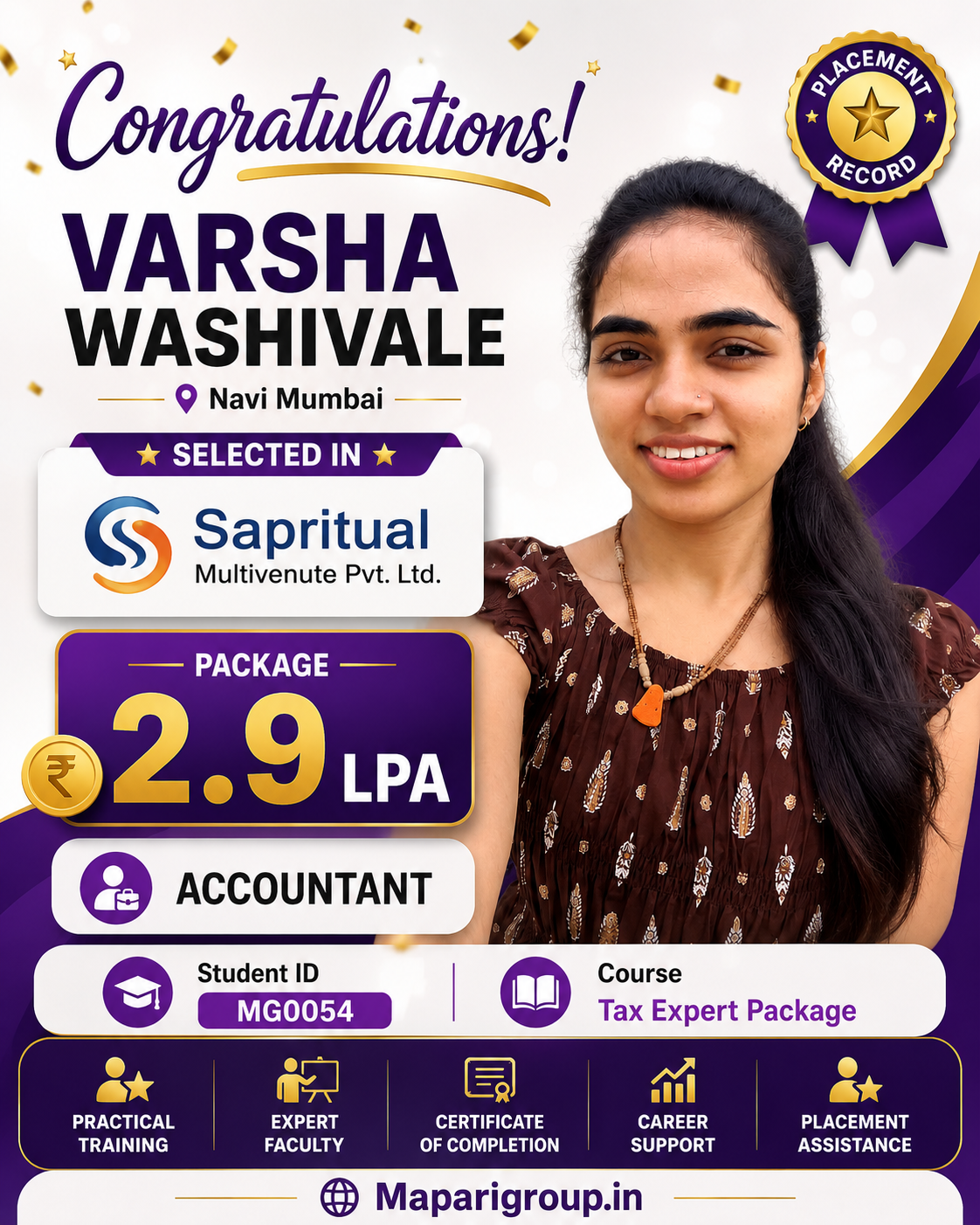
Our Placement Records
Real students. Real opportunities. Real career growth.
Your Package Value
Total value₹12,000
Accounting ₹2,000
GST Course ₹2,000
Income Tax & TDS ₹2,000
Mapari AI Subscription ₹1,000
PDF Notes ₹500
Job Portal Access ₹2,500
Dedicated Support ₹1,000
HR Interview Preparation ₹1,000
Limited-time offerSave ₹11,001 • 91.7% OFF Pay only ₹999
💳 Pay & Enroll ₹999
Secure one-time payment No recurring fee WhatsApp support
Complete Accounting & Tally
Practical career course
₹10,000
Advanced GST Practical
Registration to return filing
₹10,000
Advanced Microsoft Excel
Functions, MIS and dashboards
₹10,000
Artificial Intelligence for Accountants
AI tools and automation
₹10,000
One-Time Package Fee
₹999
Technical & Learning Infrastructure Fee
0
Students Trained
0
Modules
0
Hours Content
10
Learning Levels
Practical accounting career training at a glance
FAQ
Account Master Package FAQs
Find clear answers about the 86-module accounting course, learning access, certificate eligibility, pricing and career support.
What is the Account Master Package?
The Account Master Package is a practical accounting course with 86 modules across 10 learning levels, covering accounting foundations, daily business accounting, GST, income tax, TDS, payroll, MIS, financial analysis, accounts management and Zoho Books.
What software and skills are included?
The syllabus includes TallyPrime, Zoho Books, Microsoft Excel, Advanced Excel, MIS, ERP fundamentals, GST and other practical accounting workflows.
Who can join this accounting course?
Beginners, commerce students, graduates, working accountants and learners preparing for Accounts Assistant, Junior Accountant, GST, Tally, MIS or Accounts Manager roles can join.
What is the Account Master Package fee?
The limited-time offer is ₹999 as a one-time Technical & Learning Infrastructure Fee. The listed package value is ₹12,000, saving ₹11,001. There are no recurring charges for the included recorded course access.
How long will I have access to the course?
The included recorded lessons and learning materials are provided with lifetime course access, subject to the platform’s applicable terms and policies. Live sessions, support services and job-portal access follow the terms stated in your enrollment confirmation.
How do I become eligible for the certificate?
Certificate eligibility requires completion of the required lessons, practical assignments and applicable final evaluation or course requirements. Payment or enrollment alone does not qualify for certification.
Are practical assignments included?
Yes. Practical work may include journal entries, reconciliations, GST workings, TallyPrime and Zoho Books transactions, Excel/MIS reports, finalization projects and accounting simulations.
How does placement assistance work?
Career support may include resume guidance, interview preparation, job-role guidance, mock interviews and access to relevant job opportunities through the job portal. Placement assistance does not guarantee employment.
How long is job-portal access available?
The package includes 1-year Job Portal Access for relevant accounting and finance opportunities, subject to the applicable enrollment terms.
Can I study on a mobile phone or laptop?
Yes. The learning page is mobile-friendly. A laptop is recommended for TallyPrime, Zoho Books, Excel, reconciliation and practical accounting exercises.
Does placement assistance guarantee a job?
Placement assistance does not guarantee a job. Support includes resume guidance, interview preparation, career support, and job portal access. Final selection depends on the employer, available openings, eligibility, and the learner's performance.
Connect with Mapari Team on WhatsApp
Get quick support for enrollment, package details, and learning guidance.
Connect on WhatsApp